

November 29, 2025
HOW MUCH IS A 30-SECOND AD ON THE LATE SHOW?
On July 2, 2025, Paramount reached a $16 million legal settlement with President Donald Trump over allegations that the network tried to interfere with the 2024 presidential election by editing a 60 Minutes interview with candidate Kamala Harris. That night on The Late Show, Stephen Colbert called the settlement a "bribe" to ensure the pending merger of Paramount and Skydance would not be blocked by the administration. Fifteen days later, CBS announced that it was canceling The Late Show. Rumors began to swirl that the decision was politically motivated, especially because The Late Show had been the top rated late night show for nearly ten years.
Two months later, on September 15, 2025, Jimmy Kimmel accused MAGA of trying to use the assassination of Charlie Kirk for political gain while incorrectly characterizing the personal politics of the shooter. Two days later, ABC indefinitely suspended Jimmy Kimmel Live! Cries again arose that politically motivated actors were trying to censor free speech. Within a week, Jimmy Kimmel was back on the air after public outcry and criticism.
To assuage any political conspiracies, CBS insisted that the decision to cancel The Late Show was “purely a financial decision," adding that the show had been losing over $40 million per year for several years. The entertainment industry is notoriously opaque, as we mentioned in our story about the movie theater industry, so dozens of articles appeared trying to parse the unpublished economics of The Late Show. Since this podcast is dedicated to actual data rather than speculation, we will be looking at one particular element of the argument: advertising cost. If The Late Show is losing ad revenue every year, what is the average cost of a commercial?
In 2015, when Stephen Colbert took over hosting duties for The Late Show, CNBC published a story that ad rates for late night were rising due to increased viewership of clips online. At that time, a 30-second commercial on The Late Show was quoted to be $30,000. In 2021, Variety published that the average cost for a 30-second commercial onThe Late Show had dropped to $21,500.
This year, Simulmedia, a large television advertising placement agency, published a guide for average television advertising rates. In it, they cited a range for late night advertising on the four major networks in 2025 of $50,000 to $250,000 for a 30-second commercial. Late night is defined as 11pm - 2am, so the higher figure should be applicable for The Late Show since it commands the largest audience in that time slot, but to allow for a large margin of error, we'll assume the average: $150,000 for 30 seconds. LateNighter revealed the latest audience statistics for The Late Show to be almost 2.5 million for the first half of 2025, which represents about 4% of total viewership for CBS. According to Paramount's quarterly reports, the company nets about $2.1 billion in television advertising revenue.
The final data on advertising revenue for The Late Show comes from MediaRadar, a marketing intelligence agency that focuses on television advertising. After the announcement of The Late Show cancelation due to financial performance, MediaRadar published a breakdown of annual advertising revenue that seems to support the statement and decision. The report shows a decline in ad revenue from over $300 million in 2015 to $114 million this year.
On average, The Late Show runs 18 minutes of advertising, not counting advertising for CBS programming. And while The Late Show only produces an average of 160 episodes per year, CBS airs reruns to fill every weekday time slot throughout the year, which amounts to about 260 episodes every year. Assuming 36 30-second ads every night for 260 nights equals 9360 standard ads per year.
ESTIMATED 2025 ADVERTISING COSTS IN MILLIONS OF DOLLARS
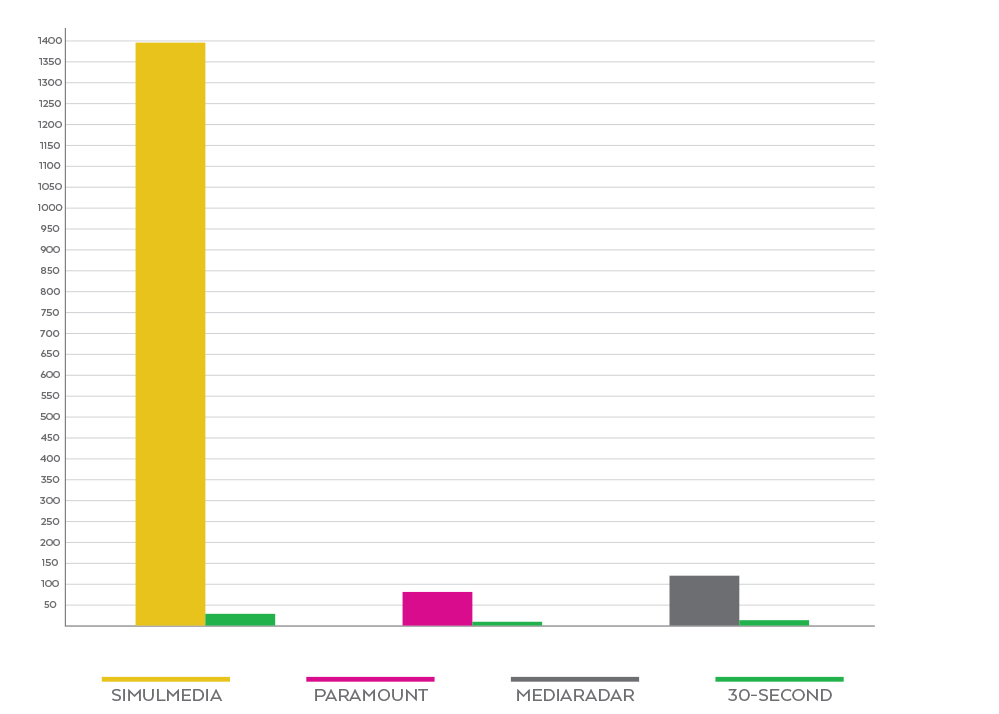
If the average cost of a 30-second commercial is $150,000, that would mean that The Late Show will make $1.4 billion in 2025. Taking 4% of Paramount's total advertising revenue yields an annual figure of $84 million for the show, which would make the average cost of 30-second commercial just under $9000. And MediaRadar quoted an annual ad revenue figure of $114 million for 2025, which amounts to an average 30-second commercial price of $12,200.
Likewise, extrapolating the figures from CNBC in 2015 and Variety in 2021 yields annual advertising revenues of $281 million in 2015 and $201 million in 2021, which are very close to MediaRadar's figures for those years, $307 million and $185 million respectively, especially considering that MediaRadar is calculating September through May like the classic television season as opposed to the calendar year. So it would seem MediaRadar's numbers are the most accurate and consistent with other media outlet reporting.
ANNUAL AD REVENUE IN MILLIONS OF DOLLARS
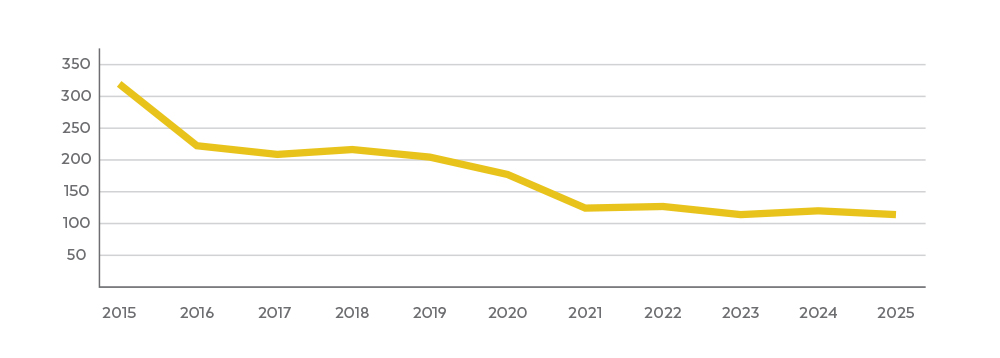
That certainly seems to indicate that The Late Show is indeed losing ad revenue every year, and at an alarming rate. In just ten years, overall advertising revenue for The Late Show has been cut by 63%. Assuming the costs to produce the show have increased every year, the fact that it is earning almost $200 million less makes the cancelation appear long overdue. And it also means we have an answer to our original question. The current cost for a 30-second commercial on The Late Show seems to be $12,200.
Which leads to another obvious question. Why is advertising on The Late Show so undervalued for the size of its audience? According to Variety, Tracker is the number one television show with a viewership of almost 13 million every week. A 30-second spot during Tracker sells for about $95,000 according to Ad Age. That's $7.30 cents per thousand viewers, which is how television ad rates are calculated. Once again, according to Simulmedia, that's minimally half the going rate for prime time, maximally 10% of the average rate. But even accepting the apparently discounted rate for CBS's top program, based on The Late Show viewership, the program should be charging $17,600 per 30-second ad. That's almost 150% higher than the current rate.
But, of course, while all of this is based on the best public data available, it's still just speculation. The wide-ranging numbers and seemingly illogical calculations are historically and endemically part of the television industry. Most advertising is part of package deals, so the isolated cost of an individual ad is nearly impossible to pinpoint. And television networks have always priced those packages on a case-by-case basis. The entire system is a remnant of an antiquated business model shrouded in secrecy. That system was fine when television was the dominant advertising platform on the planet, but that's no longer the case, and all modern advertising platforms have much clearer and publicly posted cost structures and metrics. All of this is why decisions like canceling a particular show lead to accusations and conspiracies. We will probably never know the actual reasons for The Late Show's failure and cancelation, but one thing is clear. The data behind the business reveals a larger failure on the part of CBS advertising specifically, and a failure of the entire television industry to adapt generally.
SOURCES
- "Stephen Colbert's Late Night Show Canceled, Sparking Accusations of Political Censorship; Jimmy Kimmel Incident Adds Fuel to the Fire" from the Free Speech Project
- "How Late Night is Becoming Prime-Time Online" from CNBC
- "Stephen Colbert, Trevor Noah, James Corden Unite for Google Commercial Triple Play" from Variety
- "How Much Does a TV Commercial Cost? Complete 2025 Pricing Guide" from Simulmedia
- "Here Are Final Late Night Ratings for Q2 2025" from LateNighter
- "The Colbert Effect: A Decade of Advertising on The Late Show" from MediaRadar
- "Tracker Season 3 Return Helps CBS Win Its Premiere Week in Multiplatform Viewership Ratings" from Variety
- "What Primetime TV Ads Cost in the 2024-25 Season" from Ad Age
- Revenue data from Paramount annual reports
LISTEN
SUBSCRIBE TO PULSAR NEWS


