

June 3, 2026
THE EVOLUTION OF THE SMITHSONIAN
This year, while the United States celebrates its 250th anniversary as a country, another American institution is turning 180. Established in 1846 by President James K. Polk, the Smithsonian has evolved significantly over almost two centuries. As part of the American Semiquincentennial, the Smithsonian plans to reopen its iconic carousel and its first building, known as the "Castle," in the next few months.
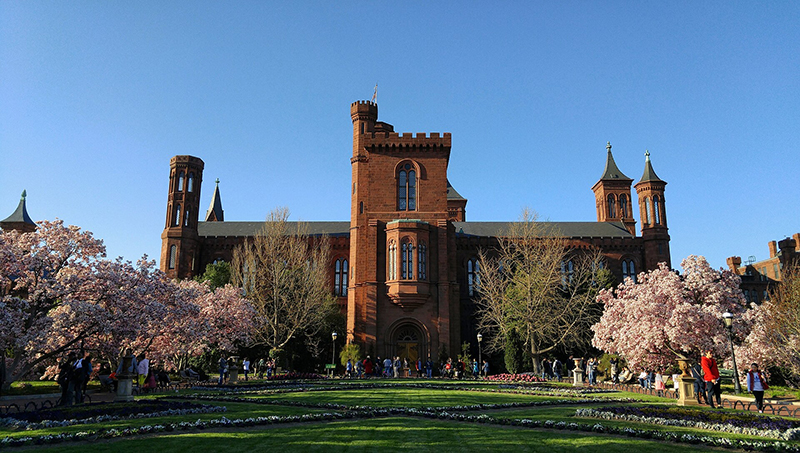
The Smithsonian Institution Building taken in April 2018. Photo by Erica Han.
The Smithsonian arose from a strange donation the United States government received in 1835. James Smithson, an English chemist and mineralogist who had never set foot on United States soil, declared in his will that if his only surviving family member, nephew Henry James Hungerford, died childless, his entire estate should pass to the government of the United States to create an establishment named the Smithsonian Institution with the purpose of increasing and spreading knowledge to all mankind. That original gift was delivered to the US Mint in 1838, and totaled $508,318.46.
The Smithsonian Institution was created as a unique federal entity that existed outside of the three branches of government defined in the Constitution, managed by a Board of Regents. The board's first act was to use Smithson's donation to build a home for the Institution. The Smithsonian Institution Building, a Norman Revival style castle, opened on the National Mall in 1855. The first donations to the Institution were various scientific apparatus.
Since its founding, the Smithsonian has grown to include 21 museums, 21 libraries, a zoo, and numerous research and education centers. Its current endowment is valued at over $2.6 billion. Let's look at how a half-million dollar gift and a dream turned into the largest museum complex in the world.
In 1838, the United States Navy embarked on a four-year exploring and surveying expedition of the world. The expedition included several scientists, including biologists, botanists, a mineralogist, a taxidermist, and a philologist. During the voyage, they collected thousands of specimens of animals, plants, rocks, fossils, archaeological relics, and cultural objects. This collection, which was almost too large to catalog, was transferred to the Smithsonian Institution in 1858. These items not only formed the foundation of the museum's collection, but they established the institution as a trusted repository for such objects, and increased donations from all over the world. The board of the Smithsonian Institution quickly realized that maintaining such a collection of artifacts was going to incur tremendous costs, so Congress also approved an annual appropriation of $4000 in 1858 in addition to the Smithson endowment. That was raised to $10,000 per year in 1870. Beginning in 1872, the appropriation became a list to maintain specific portions of the collection, and accounted for 24% of the institution's annual budget.
By 1877, the Smithsonian had amassed too many objects to store in its castle, so it petitioned Congress for funds to build an official national museum. In 1879, Congress granted the institution its largest appropriation to date, $307,500, to construct the National Museum Building (now the Arts and Industries Building). That grant represented 83% of the institution's annual budget that year.
The next large increase in funding for the Smithsonian came ten years later. William Temple Hornaday, the official taxidermist of the museum, became concerned about the possible extinction of American animal species, especially the American bison, and began housing several live animals in a shed behind the castle on the National Mall. His hope was to conserve and possibly improve the animals through scientific study, but the animals became extremely popular with the American public. In 1888, the Smithsonian requested $200,000 to construct a national zoo. The zoo instantly doubled the appropriation from Congress and became the largest ongoing expense for the institution. Throughout the late nineteenth and early twentieth centuries, Congressional appropriations provided 70-80% of the annual budget for the Smithsonian.
Throughout the first 70 years of the Smithsonian endowment, the money was maintained in a conservative account of US treasury bonds that yielded a modest amount of interest. Only the interest was used for the annual budget, making the endowment static except for two other large donations in 1858 and 1892. By 1920, the institution had received a donation of almost $2 million in stocks, which pushed the board to begin investing the fund outside the US Treasury and a few railroad bonds. So for the first time, the endowment actually began growing year over year. The fund doubled in value by 1925, doubled again by 1940, doubled again by 1960, and then doubled about every ten years to its present value of over $2.6 billion. From 1926 to 1947, the increased endowment meant that government appropriations averaged about 42% of the Smithsonian's annual operating budget.
ANNUAL ENDOWMENT, BUDGET, AND FEDERAL FUNDING IN MILLIONS OF DOLLARS
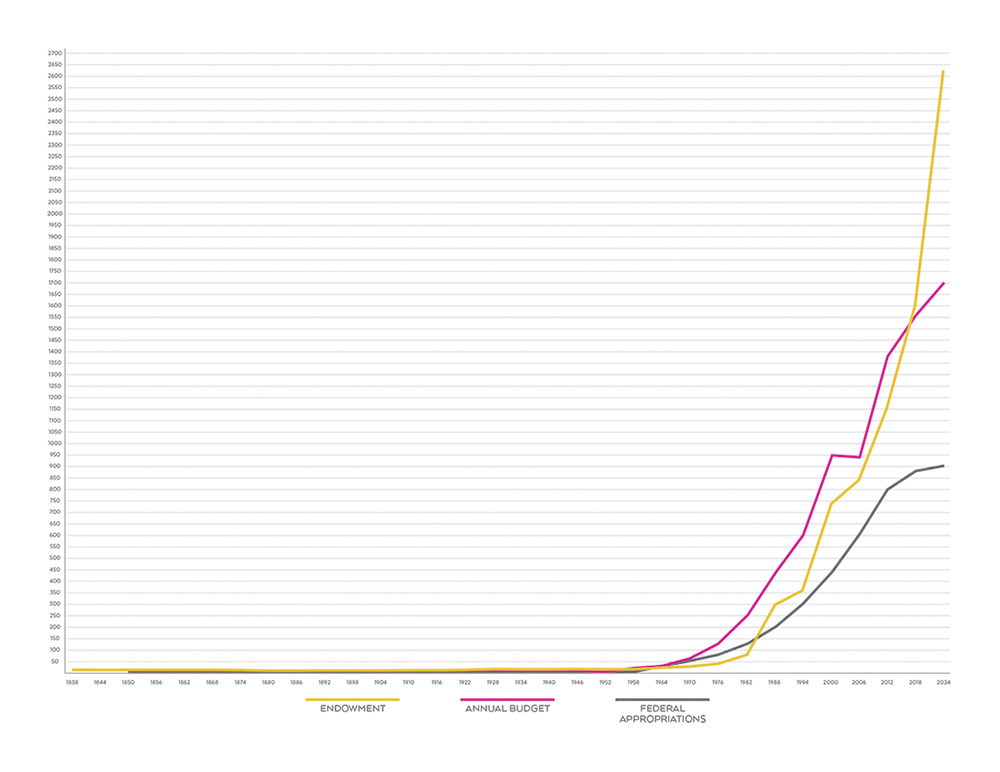
Two big economic changes occurred in the United States in the mid-twentieth century that affected the finances of the Smithsonian Institution. The United States emerged from World War II as the wealthiest nation in the world. That new wealth enabled the federal government to increase its spending. Between 1948 and 1978, federal appropriations to the Smithsonian increased from $2 million per year to over $90 million per year, and averaged 71% of the operating budget of the institution during that time, with an all-time high occurring in 1970, when Congress provided 92% of the funds to operate the nation's museums. In the decade following the war, manufacturing also skyrocketed, unemployment nearly disappeared, and wages rose to unprecedented levels, meaning not only was the federal government wealthier, so were many American citizens. By 1960, annual private donations to the Smithsonian Institution became multi-million-dollar gifts. This, along with more aggressive investing, helped its endowment grow exponentially.
In 1978, the institution began its first comprehensive inventory, determined to count every item in its entire collection. After five years, over 200 people, and one of the first government uses of computers and electronic databases, it was determined that the Smithsonian Institution held in its possession about 100 million objects. By 2009, that total had risen to 136 million pieces. Today the Smithsonian Institution houses almost 157 million objects, the majority of which are 148 million scientific specimens at the National Museum of Natural History. By contrast, the next largest museum collection in the world is about 8 million objects held by the British Museum.
Beginning in 1980, the Smithsonian endowment grew 8.8% annually and its federal appropriation settled in around 50% of its operating budget. That trend has held steady to the present day. Last year, the Smithsonian endowment was valued at $2.6 billion and its annual operating budget was $1.7 billion, with $900 million funded by the federal government. In addition to its existing 21 museums, the Smithsonian Institution has plans for two additional museums on the National Mall, the National Museum of the American Latino and the American Women's History Museum. In 2024, they launched a two-year campaign to raise $2.5 billion in order to improve all of the museums, create an online portal to view the entire collection, celebrate the Semiquincentennial with special exhibitions, and expand its scientific research and education. The goal was surpassed in less than one year. This was the largest fundraising effort in the history of any cultural organization in the world, demonstrating that James Smithson's dream lives on today as one of the most unifying institutions on the planet.
SOURCES
- "What is the Smithsonian Castle? DC landmark to reopen for America250" from Delaware Online
- "Smithsonian Institution General History" from Smithsonian Institution Archives
- "The United States Exploring Expedition, 1838-1842" from Smithsonian Institution Archives
- "Architectural History of the National Museum Building (Arts and Industries), 1879" from Smithsonian Institution Archives
- "National Zoological Park" from Smithsonian Institution Archives
- "The Post World War II Boom: How America Got Into Gear" from History
- "How Many Objects does the Smithsonian Have?" from Smithsonian Institution Archives
- "The Object at Hand: 200 Down, 136 Million Objects to Go" from Smithsonian
- "Facts About the Smithsonian Institution" from Smithsonian Institution Archives
- "British Museum Collection Fact Sheet" from the British Museum
- Revenue data from Smithsonian annual reports
LISTEN
SUBSCRIBE TO PULSAR NEWS


